Sunday, August 1, 2010

Letter to NCKU president, Kao Chiang

From:
11/6/2003 9:33 PM
Subject: Regarding pending matters related to my illegal dismissal in
1999To: Kao Chiang
CC: moe , eyemail@eyemail.gio.gov.tw,
peu03@mail.gio.gov.tw, mail@mail.moe.gov.tw, vp@mail.oop.gov.tw,
Control Yuan

Kao Chiang,
President, National Cheng Kung University
Tainan, Taiwan

cc: Office of the Premier, Minister of Education, Control Yuan, Taiwan
Commission on Human Rights

6 November 2003

Dear President Kao,

I think it's about time that the university administration issued a
formal apology for the misconduct of officials involved in my illegal
dismissal in 1999. This apology is long overdue. It is, indeed,
routine for officials of a reputable university to issue an apology
following a superior ruling in an appellant's favor. It should be
considered an even more urgent matter considering the flagrant legal
rights abuses that officials of our university committed.
In addtion, as you know, the current administration defied that
Ministry of Education ruling (8 January 2001) for more than two years
before complying. I believe officials owe not only me but Ministry of
Education officials apologies for their noncompliance with a legal
ruling.
Finally, the issue of the student engaged in misconduct at our
university must be settled at the formal level. This means the student
must be called into an official meeting for this purpose, prepared to
submit both an apology and an admission of wrongdoing.
Let us resolve these matters, not only in respect of principles of
justice, but also of our university's reputation.

Sincerely,

Professor Richard de Canio
Department of Foreign Languages and Literature
National Cheng Kung University
Tainan, Taiwan
(06) 2378626

The China News: Concerning Human Rights Absues at National Cheng Kung University

11/9/2003 12:11 AM
Subject: Concerning human rights abuses at National Cheng Kung
UniversityTo: louwei.chen@msa.hinet.net


Ms. Chen
The China News

9 November 2003

Dear Ms. Chen,

I would like to update you on recent events.
As you know, there have been repeated violations of laws at
National Cheng Kung University. I believe you contacted the Ministry of
Education and the NCKU Faculty Union to confirm this. These abuses
showed no regard for the rights of faculty or the reputation of the
university.
A culture of arrogance has developed among some officials at our
university. They don't believe they should enforce the law but that
they are the law.
This belief discredits democracy in Taiwan. Democracy is a
government of laws, not officials.
But at NCKU, officials "interpret" or select laws for personal
ends. So they use an Employment law in one case and the Teacher's law
in another. They "interpret" a Ministry ruling and obstruct justice for
more than two years. They claim a final appeal is not final. They
invoke laws or ignore them at will. They decide whom to harass or
protect, claming to be lawful either way.
For example, a student's secret letter was promptly circulated at
hearings to insure my dismissal. Yet for more than two years I've tried
to have this student disciplined, with no success. The Dean of Student
Affairs, Ko Huei-chen has used every tactic of delay and every excuse to
prevent it.
Does a dean have the right to decide the duties of her office? Is
National Cheng Kung University a lawful institution or is it controlled
by a gang with official titles and a lawyer to represent them?
But a lawyer cannot excuse them. Democracy is a government of
laws, not lawyers. Since when do lawyers replace laws in a democracy?
Can a lawyer defy a Ministry ruling and cost taxpayers millions of
dollars in needless litigation and back pay?
At issue are not only laws, but also moral principles. Officials
who appeal to human rights to criticize Mainland China ignore the rights
of foreigners here. But they lack the moral sense to understand this is
wrong in Taiwan if it's wrong in Mainland China. Like children, they
think of themselves with no respect for the rights of others.
Thus the idea of compromise is beyond their understanding.
Although I promised not to pursue the dismissal of the student mentioned
above if she apologized, I was ignored. Instead I was asked to show
sympathy for her and drop the case. Yet officials repeatedly revive
accusations against me, even after a Ministry ruling in my favor. What
happened to the principle of sympathy? In the same way, officials
ignore my patient appeal for justice, then blame me for filing lawsuits.
Such officials may lack a normal sense of shame. Young people and
some criminals seem to have a more developed sense of shame than
officials involved in this case have shown.
Although I won the Ministry ruling, I am denied a formal apology.
Instead, the university lawyer contests my right to compensation,
although the International Charter for Human Rights considers
compensation a right.
A final appeal is also a right. Yet officials still revive
accusations I defended against at the Ministry hearing.
Taiwan claims to be a democracy. But a democracy needs constant
care. Old habits die hard. Some officials find clever ways to use laws
to suit themselves rather than the law. They interpret laws as they
wish and solicit or ignore accusations as they choose. This looks like
rule by law but it's really law by rule-an unchecked power to accuse
some but excuse others. This is not the road to democracy but the end
of the road.
Such behavior is encouraged by supervisory agencies that fail to
punish officials who not only violated rights, but also defied a
Ministry ruling. Instead, the current university president, Kao Chiang,
will likely be reconfirmed by the Ministry of Education. Meanwhile, the
Control Yuan claimed, without reasons, that nothing was improperly
done. In other words, there are laws in Taiwan, but no law, since laws
can be ignored without penalty.
However, laws are useless unless abuse of the law, or due process
of law, is exposed. For this reason, Thomas Jefferson believed a free
press was the main arm of a free government.
Apart from my own rights, neither Taiwan education nor Taiwan
democracy can prosper ruled by a gang of unethical bureaucrats more
concerned with protecting themselves than upholding laws and moral
values.

Sincerely,

Professor Richard de Canio
Department of Foreign Languages and Literature
National Cheng Kung University
(06) 237 8626
(06) 2757575-52235

Letter to the Control Yuan in Taiwan

11/12/2003 10:31 AM


11 November 2003

An Open Letter to the Control Yuan

cc: The China News

Dear Control Yuan members,

I find it beyond belief that your two rulings on the case of my illegal
dismissal from National Cheng Kung University in 1999 found no official
misconduct. Even worse, as I understand, no reasons were given for your
conclusion. Yet rulings by the highest watchdog body in Taiwan should be
based on legal principles.
If secret meetings, unproved accusations, and the circulation of a
secret letter at official hearings are acceptable, why claim human rights in
Taiwan? If laws can be ignored, there are laws but no law.
Abuses at our university went beyond ignoring laws. The university
president and his lawyer defied a Ministry ruling for more than two years,
costing taxpayers millions of dollars. A watchdog body should protect its
citizens, not the officials who betray them.
After the appeal, the university argued that foreigners have no right
to appeal. This would be shameful to argue before the ruling, but shameless
to argue after it.
The university then contested the ruling in court. This was not only a
slap in the face of the law. It showed scorn for moral principles by an
institution of higher learning supposed to uphold those principles.
Schools teach honesty, fair play, and obedience to the law. By law,
officials must comply with rulings. A final appeal is final, not subject to
revival. A legal challenge is made before the ruling, not after it.
Officials execute laws; they don’t “interpret” them. Only the high court
interprets laws.
But unpunished for their misconduct, officials prosper by it. The
university president was reelected to a second term, yet I have still not
received a formal apology. I have still not received compensation.
Accusations discredited at the Ministry hearing are repeatedly revived.
Rights were ignored to discredit me with a secret student letter, then used
to protect the student from punishment.
Officials rely on rights when living abroad but deny them to foreigners
here. This not only violates the law, but also moral principles known in
both Western and Confucian societies.
Confucius said a gentleman admits his mistakes. Yet our officials lack
moral sense to do so. They are a law to themselves. Like children, they
are sore losers. They don’t admit wrongs or apologize. They say they’re
right, though they’re proved wrong. Their feelings are easily hurt but they
easily hurt the feelings of others. Their sense of compromise is to give
half of what’s due. Their way of harmony is to make others do things their
way. They enforce laws by deciding which to enforce. Their idea of justice
is to cooperate with unjust colleagues. They are less concerned with the
force of law than with the pressure of relationships.
This fits the profile of juvenile offenders more than that of public
officials. Except juveniles have a sense of shame.
Rulings, like rules, are tested by general use. According to your
ruling, there are laws but no law, or enforcement of laws. Laws are for
officials to interpret, apply, or ignore at will.
Such rulings encourage a culture of arrogance among officials. They
think they are the law instead of answerable to the law.
This caused the SARS crisis last year, as you recognized in blaming
hospital officials. But though you blame officials for not enforcing laws
at a hospital, you find officials blameless for not enforcing laws at a
university.
Confucius warned we must correct the names. Defiance of a Ministry
ruling should not be called “interpretation of the law” if it’s obstruction
of justice. Secret accusations and revival of discredited accusations
should not be called review if it’s harassment. Administrative remedy that
takes years is no remedy.
Confucius said the Tao does not enlarge man but man enlarges the Tao.
Heaven does not give us justice but only the power to exercise it. I ask
that you exercise that power.
I have therefore appealed to the Control Yuan appeal committee.
I request punishment of officials involved in my dismissal.
I request full compensation.
I request an admission of wrongdoing and a formal apology from my
university.
I request formal discipline of the student who wrote a malicious letter
secretly circulated at my dismissal hearings.
I request punishment of the dean who has prevented a formal meeting
with this student.
The policy in Taiwan whereby the feelings of Taiwan officials are
placed above the rights of foreigners must stop.
This is not only an issue of rights. Foreigners have feelings too.

Sincerely,

Professor Richard de Canio
Department of Foreign Languages and Literature
National Cheng Kung University
Tainan, Taiwan
(06) 237 8626
(06) 2757575-52235

Letter to Taiwan Ministry of Education

12/10/2003 10:36 PM


Ministry of Education
Department of Higher Education

cc: Prime Minister's Office, Human Rights Commisssion,
Control Yuan,

10 December 2001

Dear Ministry of Education Officials,

Once again I am writing you to remind you that officials at
National Cheng Kung University are in violation of my legal
rights.
I remind you that on 8 January 2001, I won a Ministry of
Education
Appeal ruling, which, due to countless legal rights
violations committed
by university officials, rejected my dismissal from
National Cheng Kung
University.
The NCKU administration promptly ignored that ruling and
delayed
enforcement for more than two years. Then no sooner did
they respect
that ruling (May, 2003) than they held a new committee
hearing to repeat
accusations already rejected in that ruling.
Regardless what you call it in Taiwan (in Anglo-American
law we
call it protection against double jeopardy), it is obvious
that if,
following an appeal, the party that lost the appeal can
revive the same
accusations, an appeal is without purpose. Who's going to
appeal if the party with more power can continually revive
the
accusations?
These are not the only issues that should concern you. The
accusations themselves are without basis, without proof,
without even
criteria. The university defied a Ministry ruling for more
than two years. The university has engaged in countless
legal rights
violations over the past four years. Yet not a single
official has been
punished or, so far as I know, even warned about these
violations.
Instead, they keep repeating their misconduct, as if doing
so makes it
right.
Today I received another notice from the university,
reaffirming
its decision to withhold my salary increments for six years
for
accusations never proved, already rejected in the Ministry
ruling of
8 January 2001, and even overturned by a university appeal
committee!
Are these officials a law to themselves or are they bound
by Taiwan
law? If they are bound by Taiwan law, why aren't they
punished by
Taiwan law?
This case is doubly shocking. Not only are legal rights
being
violated and laws ignored, but also basic moral principles
a university
should uphold, such as respect for laws and arbitration,
fair play, and
other values we teach young children.
These principles should concern you, especially regarding
an
academic institution of higher learning. The other
principle, of
course, is that I should receive full protection under
Taiwan law, no
less than Taiwan citizens receive full protections under
American law.
I cannot accept abuse of my rights here. I won a ruling
sanctioned
by the Ministry of Education. It is the responsibility of
your Ministry
to enforce that ruling according to protections and rights
guaranteed
under Taiwan law.
This is now the fifth year since my illegal dismissal from
the
university. Yet not only haven't officials been punished
for their
misconduct but they are repeating the same misconduct.
Clearly it's time for the Ministry of Education to take
action
against officials involved, prevent future misconduct, and
insure my
rights, as Taiwan citizens are insured their rights in my
country.

Sincerely,

Professor Richard de Canio
Department of Foreign Languages and Literature
National Cheng Kung University
(06) 237 8626

Laws must be enforced at National Cheng Kung University

12/11/2003 9:58 AM
Subject: Laws must be enforced at National Cheng Kung
UniversityTo: moe
CC: Control Yuan ,
Vice-President Lu

Ministry of Education

11 December 2003

Dear Ministry officials,

These abuses at National Cheng Kung University cannot be allowed to
go on for much longer. The Ministry of Education must do something
about the lawlessness at our university. I expect Ministry officials to
establish principles of law here. Send officials to Tainan and resolve
these problems.
Democracy is a government of laws, not committees. The belief that
so long as committees violate laws, then it's all right is not an
acceptable principle in a democracy. The principle that if one person
does something wrong it is wrong, but if 15 officials do something wrong
it is right is not a principle of democracy. The International Charter
for Human Rights has made this very clear already.
I repeat: Democracy is a government of laws. Committees cannot
change the laws, only act in accordance with the laws.
I won a Ministry ruling on 8 January 2001. No committee at
National Cheng Kung University can change the legal benefits of that
ruling. The latest action by the university, claiming to cancel my
increments for six years, is not only wrong based on the Ministry
decision; but it is wrong based on a ruling by National Cheng Kung
University appeal committee as well. How long are you going to tolerate
the mockery of law at our university?
If the Ministry of Education does not realize it is time to send
officials to Tainan to impose law in our university, then when will the
Ministry think it's time?
One thing for certain: I intend to defend my rights here, even if
I have to appeal outside of Taiwan to do so.

Sincerely,

Professor Richard de Canio
Department of Foreign Languages and Literature
National Cheng Kung University
(06) 237 8626

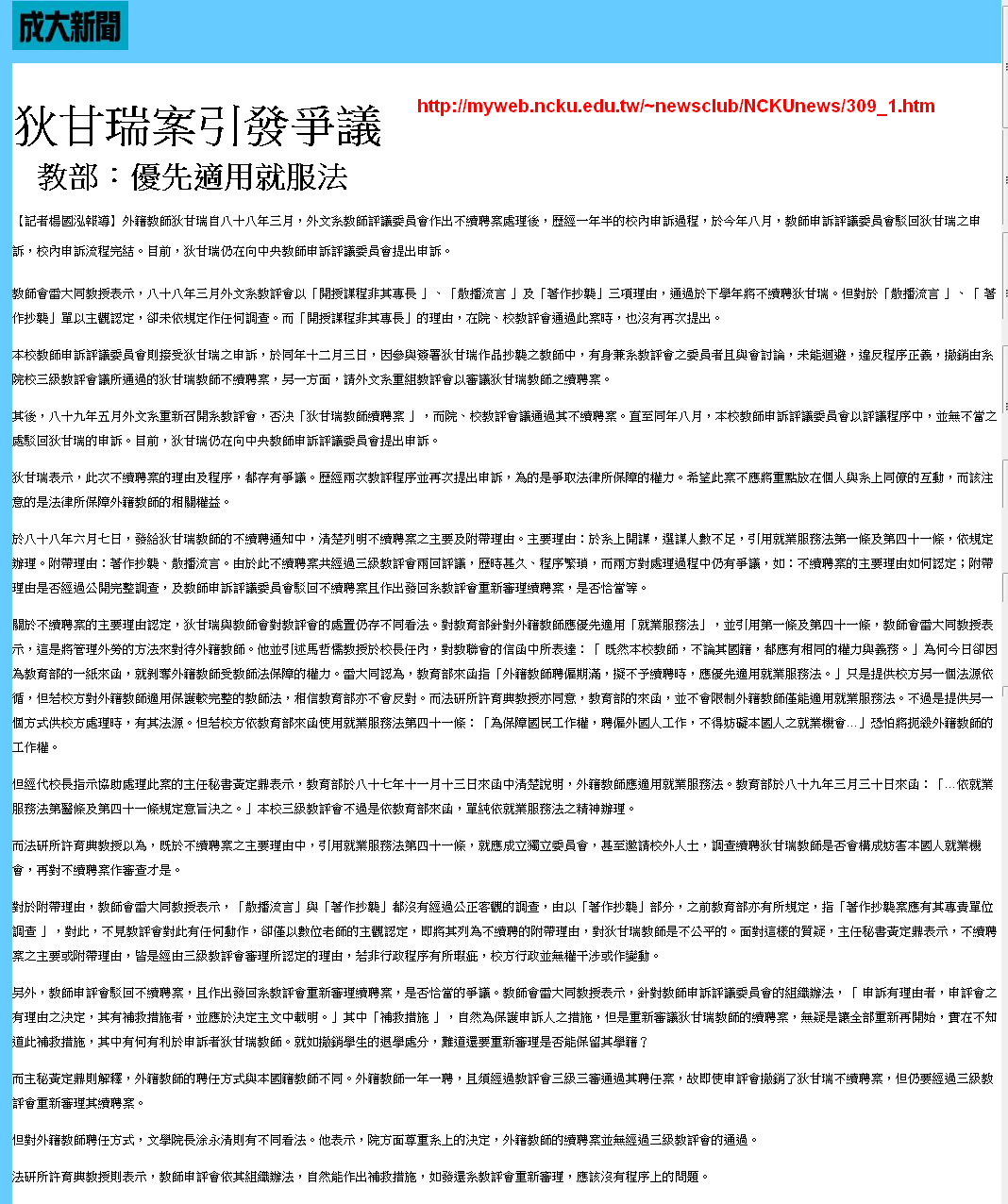
National Cheng Kung University Student News (2000)

NCKU Student Newspaper Reports on the Illegal Dismissal Case at National Cheng Kung University

http://myweb.ncku.edu.tw/~newsclub/NCKUnews/309_1.htm