From:
-----Original Message-----
Sent: Tuesday, July 16, 2002 4:20 AM
To: rquinn@midway.uchicago.edu
Subject: Re: Abuses at National Cheng Kung University in Taiwan
Scholars at Risk,
Robert J. Quinn,
Director
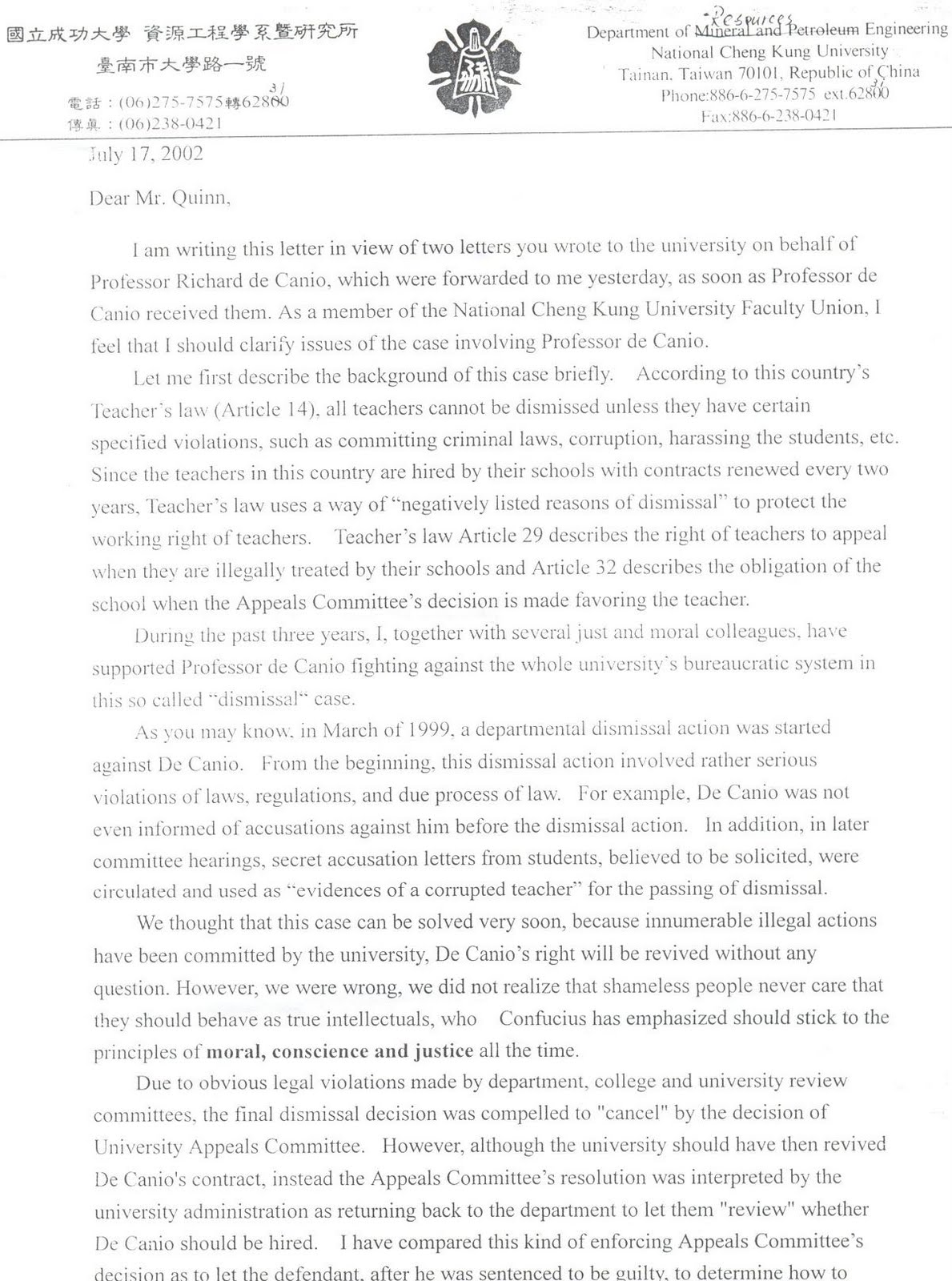
17 July 2002
Dear Mr. Quinn,
Today I received copies of the letters you wrote, on behalf of
Scholars at Risk, to Professor Kao Chiang, president of National Cheng
Kung University. One letter was dated 24 August, 2001; the other was
dated 18 October, 2001. Regretfully, due to the circumstances with
which you are familiar, I was unable to access my mail at my
departmental mailbox until today, when a colleague delivered the mail
to
me personally.
Although, as you know, I was legally reinstated by the Ministry
of
Education in early 2001, due to the university’s defiance of this
ruling, I believe it best to avoid contact with the university until
the law is enforced.
First of all let me thank you for your strong support of the
principles involved in this case, as is shown in the copies of your
letters. I am grateful for this, although I regret I was unaware of
the forceful content of these letters until today.
At the same time I was dismayed by the note, penned on a page of
one of your letters, by President Kao, seeming to dismiss your
strongly
stated concerns by appealing (under the circumstances, cynically) to
“laws, regulations, etc.”
Based on the documented facts of this case one wonders what laws
and
regulations he refers to. Because the university has repeatedly
defied,
not only its own written laws and principles, not only rulings by the
Ministry of Education, but universally recognized moral principles as
well.
As is well documented, officials held secret meetings; they
circulated secret and libelous letters; they (punitively) evaluated
foreigners, but not native teachers; they claimed that foreigners are
not protected by the Teacher’s Law, although in a recent letter the
Ministry of Education has stated otherwise; they scorned their own
appeal ruling in my favor, as well as the Ministry’s final ruling,
claiming that winning an appeal simply allowed me to appeal again,
although the Ministry (not to mention universal principles) has
challenged this claim; and, now, shamelessly, the university lawyer
has
argued in court that foreigners don’t even have a right to appeal,
although the university never challenged this right until after I won
the appeal!
Apart from previous appeal hearings in my case, the university
recently held yet another appeal hearing, which patently belies the
lawyer’s claim in court that I have no right to appeal. How can the
university administration claim two contradictory legal principles at
the same time, changing from one to the other depending on
convenience?
The obvious answer is they don't believe in legal principles.
Apparently holding appeal hearings in my case legitimates their action
with the Ministry; yet challenging my right to appeal legitimates
their
dismissal action in court. It’s apparent that university officials
care
neither about logic nor morality; they only care about effecting their
goals.)
The university lawyer was, as I’ve been informed, even chastised
by
the judge for suppressing the Ministry’s ruling in my favor, making it
appear to the court that an appeal never took place! Fortunately, a
member of the university Faculty Union, acting as my legal counsel,
submitted copies of the Ministry decision, as well as strongly worded
followup letters, enjoining issuance of my contract.
Apart from rights and laws, what are the moral principles of a
university administration that challenges a final appeal, not on
legitimate legal grounds but simply because university officials don’t
want to lose? Yet, despite the university’s obvious defiance of both
law and moral principles (the Ministry decision, fair play, keeping
one’s word, honesty, etc.), the Taiwan court has delayed a judgment in
this case, which has now lasted about a year!
Thus, as you yourself suggest in one of your letters, the problem
is wider than National Cheng Kung University, which is doubtless why
the
university has confidently mounted its challenge against the Ministry
ruling in the first place. The concept of a rationalized and routine
justice, including rights and due process, along with punitive
sanctions
against those who violate these principles, is certainly an alien
concept here, at least based on the documented abuses at National
Cheng
Kung University and the failure of judicial agencies, including the
courts, to sanction these abuses.
Yet any one of these documented abuses would have discredited a
university official on legitimate review in other democracies, with
significant press coverage. (A technical issue of conflict of
interest
at a Hong Kong university several years ago captured media headlines
and
catalyzed students and faculty. I know, since I was in Hong Kong at
the
time.)
To update my case, despite the Ministry ruling in my favor,
despite
continued warning letters from the Ministry of Education that the
university must issue me the contract and related benefits, and
despite
President Kao’s assurance that “we will do everything according to our
laws,” the university remains in defiance of the Ministry ruling.
Furthermore, it continues to harass me with yet further hearings in my
case based on the same accusations rejected in the Ministry ruling.
The
last hearing was about a month ago. The university also violated the
deadline for issuance of its formal ruling, although we heard about it
from a committee member sympathetically concerned about my case.
Apparently the committee chair plans to issue a decision
concluding
that, although there was a legal basis for my appeal, nonetheless the
university would not issue me a contract anyway. It is unclear what
the
basis of this argument will be, but the very fact that committee
members
are not even certain what the decision will be shows how dubious
democratic process is. One would think that committee members would
know what it is they are voting for! But apparently, despite the
presence of about fifteen committee members, it is the chairman who
decides how to write the decision, not merely in terms of style but in
terms of substance!
However, as a colleague told me several days ago over the phone
(and
this sums up the legal issues), the committee hearings after the
Ministry ruling are a legal travesty anyway. How can a committee
adjudicate a case already won on appeal?
Therefore I urge you, on behalf of all foreign faculty in Taiwan
and
in the name of those principles you recognized in your two letters, to
pursue this case as you have done, especially in light of President
Kao’s facile assurance of lawful observance; which, considering
documented abuses, suggests a cynical confidence in the power of his
office above the authority of the law.
In the meantime, the Ministry of Education plans to send a yet
more
strongly worded letter that the contract must be issued in accordance
with the law. Also, a member of the Faculty Union hopes to send you a
letter soon in response to copies of your letters that I sent him
today.
Thank you once again for your support. And, again I apologize for
my tardy update, as explained above. Since I did not hear anything
further from you by email, and since you are naturally preoccupied by
cases besides my own, I was uncertain whether further updates were
appropriate.
Sincerely,
Richard de Canio.
Showing posts with label July 17 2002. Show all posts
Showing posts with label July 17 2002. Show all posts
Monday, August 2, 2010


Tuesday, July 27, 2010
[Fwd: Regarding human rights abuses at a Taiwan university]




-------- Original Message --------
| Subject: | Regarding human rights abuses at a Taiwan university |
|---|---|
| Date: | Fri, 02 Oct 2009 09:58:16 +0800 |
| From: | rdca25@gmail.com |
| To: | crnelson@illinois.edu |
| References: | <4A5E870C.1080001@gmail.com> <001c01ca05de$34a5f350$6822748c@pjP> |
President,
American Association of University Professors
2 October 2009
Dear President Nelson,
.
I have had long-standing problems regarding human rights abuses at National Cheng Kung University (NCKU) in Tainan, Taiwan. In 2001, Taiwan's Ministry of Education canceled my illegal dismissal (1999-2000), boldfacing human rights violations. Instead of reinstating me, NCKU argued foreigners had no right to appeal, even though the university held appeal hearings and attended Ministry hearings!
After defying Ministry of Eduction directives for more than two years, the university finally reinstated me in 2003, but without formal redress. NCKU currently has many academic exchanges with US universities. But as a professor and American citizen, I do not believe disregard for human rights should be a basis for academic exchanges with a university in a democratic country, especially my own.
Currently several high-ranking NCKU officials are American citizens or have benefited from American democratic values. They have ignored my petitions to formally resolve this case with apologies, penalties, and compensation according to internationally recognized principles of law.
Our universities should not maintain academic exchanges with a university that flagrantly violates human rights and scorns human rights principles. Academic exchanges should entail some degree of reciprocity.
If, as was stated on the Purdue University news page, NCKU "is one of the most outstanding universities in Asia, if not the world," one must question if human rights are relevant in this assessment, or if human rights are relevant at all.
The current president, Dr. Michael M. C. Lai, hasn't even responded to several requests to discuss this issue. Apart from not honoring an appeal the university itself participated in, the fact that NCKU would try to enforce discriminatory practices against foreign faculty should concern American faculty in the US. Under the circumstances, I wish you can inform me what my options are, since there is no juridical leverage in Taiwan.
Taiwan's courts seem to take away with one hand the rights they give with the other. It reminds me of a line from a Shakespeare play, "I can call the dead too, but will they come?" Yes, you can sue officials in Taiwan, but will you win?
For example, the courts imposed no penalties on university officials, though the violations were egregious, willful, and defiant. Other court cases were a waste of time and money.
In my suit against a student who wrote a secret accusatory letter, the court ruled it was not libel since no one outside the university read it! Yet the student's letter was secretly circulated at appeal and review hearings! According to most libel laws, a third party is sufficient to constitute libel!
Similarly, my suit against Review Committee members who made unproved accusations was dismissed on the basis the accusations were not circulated outside the department!
Another court ruled against compensatory damages (travel costs incurred to renew my visas), insisting there was no need for me to have stayed in Taiwan! But when an American left Taiwan during a child custody dispute, the court ruled that by leaving Taiwan the father proved he had no interest in the child and awarded custody to the mother!
In other words, "Heads I win, tails you lose." I won the contract case presumably because the court had to uphold a Ministry ruling or risk an international scandal. But the wonder is it accepted the university's case at all, based on no acceptable legal principle. Still, the court imposed no punitive damages on the university and awarded no compensatory damages to me.
Such rulings increase the risk among foreign faculty in Taiwan, who are less likely to fight for their rights. I believe a US court would have imposed millions of dollars in punitive damages on a university that behaved with such willful defiance as this university has (see attachments).
Taiwan English-language newspapers, which preach independence "in the name of democracy" have ignored my letters as have Taiwan human rights groups. Meanwhile, Chinese-American academics seem indifferent to democratic principles once they become local officials.
I'm not sure what can be done abroad. But these issues should concern human rights activists, universities, and faculty abroad. American universities should not maintain academic exchanges with a university that flagrantly violates human rights and scorns human rights principles. Academic exchanges should not be construed merely as economic exchanges but should be based on human rights principles, not to mention principles of reciprocity.
I write not only as a victim of human rights abuses in Taiwan but on behalf of all Americans who teach here who may have been, or will be, subject to similar abuses without redress.
Under the circumstances, I can only hope for assistance, or at least advice, from American professors abroad. For example, does an American citizen have legal leverage to request that an American university suspend academic exchanges with a foreign univesity that has been proved to have violated human rights? (Please see attachments.)
I appreciate whatever assistance or advice you give. My main goal is to effect just closure in this case, based on principles of international human rights laws.
Sincerely,
Richard de Canio
Department of Foreign Languages and Literature
National Cheng Kung University
Letters from Taiwan's Ministry of Education to National Cheng Kung University's President
Regarding Enforcement of an Appeal Ruling
These are English translations of eight letters from the Ministry of Education to National Cheng Kung University concerning my illegal dismissal and the university's refusal to abide by a legal Ministry ruling, even though the university participated in appeal hearings and only challenged my right to appeal after the ruling favored me. It even filed a lawsuit to challenge the Ministry's ruling, then used the court case to try to further delay issuing the contracts!Regarding Enforcement of an Appeal Ruling
(The translations are by a member of the NCKU Faculty Union. Chinese copies are attached in JPEG and PDF formats. Below are paraphrases. In any version, the unprincipled conduct of National Cheng Kung University is evident.)
1. April 6, 2001: "The university should make lawful remedy within a month."
2. May 11, 2001 "The university should first revive the contract with Mr. De Canio, which is the proper remedy."
3. June 14, 2001 "If there is no practical revival of the contract, the decision of the MOE Appeals Committee is equivalent to vain words. Procedural justice should be upheld first. The university should not use the results of its previous improper procedures as an excuse to delay reinstating the professor."
4. August 7, 2001 "If the university willfully delays so as to damage the teacher’s rights, the university must bear complete responsibility."
5. May 3, 2002 "The university should first revive the contract with Mr. De Canio starting from August 1, 1999, and compensate his salary. There is no need to wait for the court verdict."
6. October 15, 2002 "The university should immediately process the application of contract extension permit."
7. December 2, 2002 "The university’s request to wait for the court verdict is denied. Revive the contract with Mr. De Canio and compensate his salary as soon as possible."
8. January 17, 2003 "Do as described in the letter of December 2, 2002."
[Fwd: Regarding human rights abuses at a Taiwan university]


-------- Original Message --------
| Subject: | Regarding human rights abuses at a Taiwan university |
|---|---|
| Date: | Fri, 28 May 2010 00:59:02 +0800 |
| From: | rdca25@gmail.com |
| To: | humlaw@wcl.american.edu |
| CC: | hrbrief@wcl.american.edu |
| References: | <4A5E870C.1080001@gmail.com> <001c01ca05de$34a5f350$6822748c@pjP> |
Human Rights Brief
28 May 2010
Dear Faculty and Students,
I have had long-standing problems regarding human rights abuses at National Cheng Kung University (NCKU) in Tainan, Taiwan. In 2001, Taiwan's Ministry of Education canceled my illegal dismissal (1999-2000), highlighting human rights violations. Instead of reinstating me, NCKU argued foreigners had no right to appeal, even though the university held appeal hearings and attended Ministry hearings.
After defying Ministry of Education directives for more than two years, the university finally reinstated me in 2003, but without formal redress. NCKU currently has many academic exchanges with US universities. But I do not believe disregard for human rights is a basis for academic exchanges with universities that observe human rights.
Currently several high-ranking NCKU officials are American citizens or have benefited from American democratic values. They have ignored my petitions to formally resolve this case with apologies, penalties, and compensation according to internationally recognized principles of law.
Our universities should not maintain academic exchanges with a university that flagrantly violates human rights and scorns human rights principles.
If, as was stated on the Purdue University news page, NCKU "is one of the most outstanding universities in Asia, if not the world," one must question if human rights are relevant in this assessment, or if human rights are relevant at all.
The current president, Dr. Michael M. C. Lai, hasn't even responded to several requests to discuss this issue. Apart from not honoring an appeal the university itself participated in, the fact that NCKU would try to enforce discriminatory practices against foreign faculty should concern American faculty in the US. Under the circumstances, I wish you can inform me what my options are, since there is no juridical leverage in Taiwan.
Taiwan's courts seem to take away with one hand the rights they give with the other. It reminds me of a line from a Shakespeare play, "I can call the dead, but will they come?" You can sue officials in Taiwan, but will you win?
For example, the courts imposed no penalties on university officials, though the violations were egregious, willful, defiant and lasted several years. Other court cases were a waste of time and money.
In my suit against a student who wrote a secret libelous letter, the court ruled it was not libel since no one outside the university read it. Yet the student's letter was secretly circulated at appeal and review hearings. According to most law dictionaries, a third party is sufficient to constitute libel.
Similarly, my suit against Review Committee members who made unproved accusations was dismissed on the basis the accusations were not circulated outside the department.
Another court ruled against compensatory damages (travel costs to renew my visas), insisting there was no need for me to have stayed in Taiwan. But when an American left Taiwan during a child custody dispute, the court ruled that by leaving Taiwan the father proved he had no interest in the child and awarded custody to the mother.
In other words, "Heads I win, tails you lose." I won the contract case presumably because the court had to uphold a Ministry ruling. The wonder is it accepted the university's case at all, based on no acceptable legal principle. Still, the court imposed no punitive damages on the university and awarded no compensatory damages to me. Such rulings increase the risk among foreign faculty in Taiwan, who are less likely to fight for their rights knowing even if they win they nonetheless lose in terms of the cost and years to fight the case.
Taiwan English-language newspapers, which espouse democracy, have ignored my letters as have Taiwan human rights groups. Meanwhile, Chinese-American academics seem indifferent to democratic principles once they become local officials.
These issues should be of concern to human rights activists, universities, and faculty abroad. American universities should not maintain academic exchanges with a university that flagrantly violates human rights and scorns human rights principles. Academic exchanges should not be based on economic exchanges but on human rights principles.
I write not only as an American victim of human rights abuses in Taiwan but on behalf of all foreigners who teach here who may have been, or will be, subject to similar abuses without redress.
Under the circumstances, I can only hope for assistance, or at least advice, from your Center. For example, does an American citizen have legal leverage to request that an American university suspend academic exchanges with a foreign university that has been proved to have violated human rights? (Please see attachments.)
I appreciate whatever assistance or advice you give. My main goal is to effect just closure in this case, based on principles of international human rights laws and to obtain for Americans the same protections in Taiwan guaranteed to citizens of Taiwan in America.
Sincerely,
Richard de Canio
Department of Foreign Languages and Literature
National Cheng Kung University
Letters from Taiwan's Ministry of Education to National Cheng Kung University's President
Regarding Enforcement of an Appeal Ruling
These are English translations of eight letters from the Ministry of Education to National Cheng Kung University concerning my illegal dismissal and the university's refusal to abide by a legal Ministry ruling, even though the university participated in appeal hearings and only challenged my right to appeal after the ruling favored me. It even filed a lawsuit to challenge the Ministry's ruling, then used the court case to try to further delay issuing the contracts!Regarding Enforcement of an Appeal Ruling
(The translations are by a member of the NCKU Faculty Union. Chinese copies are attached in JPEG and PDF formats. Below are paraphrases. In any version, the unprincipled conduct of National Cheng Kung University is evident.)
1. April 6, 2001: "The university should make lawful remedy within a month."
2. May 11, 2001 "The university should first revive the contract with Mr. De Canio, which is the proper remedy."
3. June 14, 2001 "If there is no practical revival of the contract, the decision of the MOE Appeals Committee is equivalent to vain words. Procedural justice should be upheld first. The university should not use the results of its previous improper procedures as an excuse to delay reinstating the professor."
4. August 7, 2001 "If the university willfully delays so as to damage the teacher’s rights, the university must bear complete responsibility."
5. May 3, 2002 "The university should first revive the contract with Mr. De Canio starting from August 1, 1999, and compensate his salary. There is no need to wait for the court verdict."
6. October 15, 2002 "The university should immediately process the application of contract extension permit."
7. December 2, 2002 "The university’s request to wait for the court verdict is denied. Revive the contract with Mr. De Canio and compensate his salary as soon as possible."
8. January 17, 2003 "Do as described in the letter of December 2, 2002."
Subscribe to:
Posts (Atom)